NEWS & ARTICLES
Why Familiar Language Matters in Dementia Care
November 3, 2026
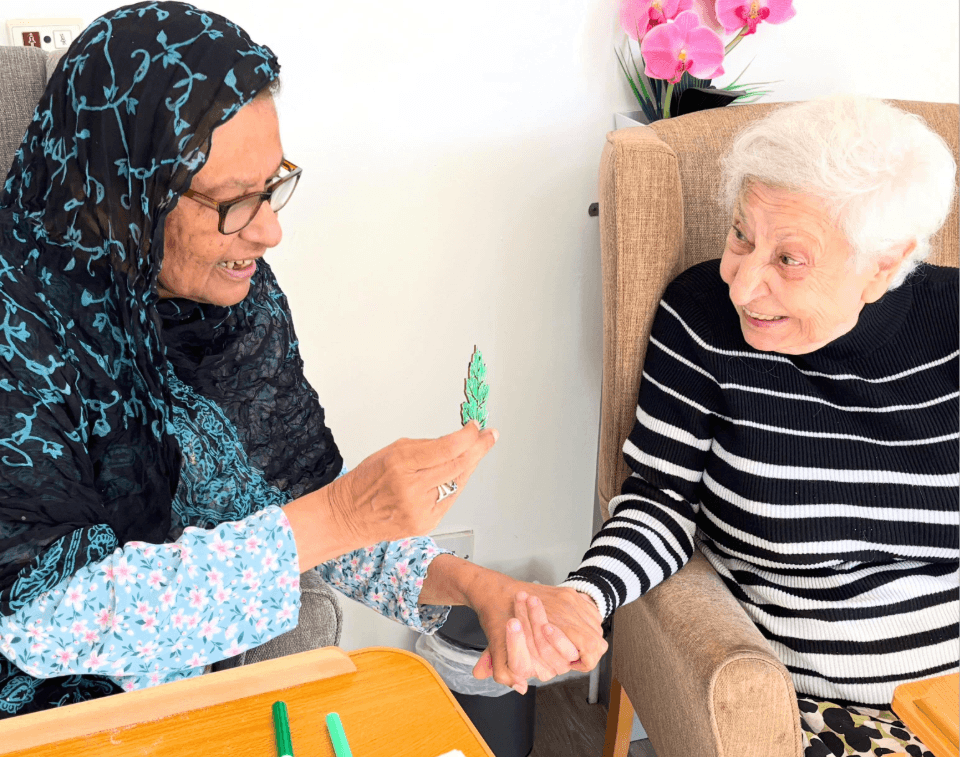
Dementia can bring back the language someone learned first, whether that is a mother tongue or a childhood dialect, and can make a later language harder to reach. Being spoken to in a familiar language helps a person feel understood, calmer and less alone. At Manor Lodge, our team speak six languages between them, and that makes a real difference to the people who live with us.
If someone you love has started speaking in a language you have not heard from them for years, or has stopped speaking English altogether, it can be unsettling. It is also more common than most families expect, and there is a lot that can help.
What happens to language in dementia
Dementia tends to affect recent memories before older ones. Many people living with dementia feel more at home in their early life than in the present, and language can follow the same pattern.
For someone who has spoken more than one language, that can mean the language learned later in life, often English for people who moved to the UK as adults, becomes harder to find. The first language, which sits deep in childhood, stays easier to reach. Researchers who have spoken to care workers in Scotland, Ireland and Wales describe bilingual people with advanced dementia who were transformed by carers who spoke their mother tongue, with music and song often unlocking words and memories.
The same applies to dialect. Someone who spent decades softening their accent for work may find the voice of their childhood coming back. A paper by Thomas McKean at the University of Aberdeen describes the isolation people can feel when they revert to a first language in a care setting where nobody understands it.
It does not happen to everyone, and it does not follow a fixed timetable. But when it does, the language around a person matters a great deal.
Why it matters in everyday care
- Basic needs get understood. Pain, thirst, needing the toilet, feeling cold. These are simple things to say in any language, and a very big deal if nobody can understand them.
- It reduces fear. Being surrounded by sounds you cannot follow is frightening, even more so when you are already confused. Hearing your own language is reassuring in a way that is hard to put into words.
- It keeps identity intact. A person's language holds their childhood, their family, their faith and their sense of humour. Being addressed in it says: we know who you are.
- It makes room for connection. Familiar words, songs and prayers often get a response when little else does.
In our experience it is often the small things. A resident who has spoken English with us for years asks for her tea in the language of her childhood, and the member of the team who understands gets a smile no care plan could ever record. Moments like that are why we take language seriously.
How we support residents at Manor Lodge
Our team at Manor Lodge come from different backgrounds, and between them they speak six languages. That is not something we planned as a feature. It is a result of hiring people who care and who come from the communities we serve. But it means that when a resident reverts to a first language, there is often someone on the team who can talk with them, not just about them.
We are honest about the limits too. We cannot cover every language and dialect in every shift. So we do three things:
- We ask early. Before someone moves in, we ask which languages they speak, which they learned first and which they use with family.
- We build a small vocabulary. Staff learn the key words and phrases for a resident, such as hello, hungry, thirsty, pain, toilet and the names of family members.
- We bring in what families and music can offer. Songs, prayers, radio and recordings in a resident's own language are part of daily life, not an occasional extra.
This sits alongside the rest of our dementia care. If you would like a feel for the home, read how we went around the world at Manor Lodge, or see what a good day looks like for a resident living with dementia.
What families can do
- Tell the home every language and dialect your loved one speaks, and roughly when they learned each one. Even a note like "spoke Gujarati at home, English at school" is useful.
- Write down the words that matter most. Everyday needs, endearments, names for family and pets. Spelling it how it sounds is fine.
- Keep speaking to them in their first language, even if the replies are short or do not come. Tone, warmth and familiar sounds still land.
- Bring in songs, prayers and recordings. Music often reaches people when conversation does not.
- Share their story. Where they grew up, what they cooked, what they listened to. It gives staff something real to talk about.
- Do not correct or test them. Switching languages is not a mistake. Meet them where they are.
If you are looking at care homes for someone who is losing their second language, ask each home how they would communicate with your loved one on an ordinary Tuesday night, not only on a good day with a visitor in the room. The answer tells you a lot.
People sometimes assume language is a bonus in care. We see it as part of the care itself. If you cannot make yourself understood when you are in pain or scared, nothing else in the day works properly. A home that treats language as part of dignity will always have the edge over one that treats it as a nice extra.
Frequently asked questions
Is it normal for someone with dementia to stop speaking English?
It is not unusual for people who learned English later in life. As dementia progresses, the later language can become harder to reach while the first language stays. If you notice a sudden change, mention it to the GP or care team so they can check that nothing else, such as an infection, is playing a part.
Does reverting to a first language mean dementia is getting worse?
It can be part of how dementia progresses, but it is not a measure on its own. What matters is how well your loved one can communicate and feel understood, and how the people around them respond.
What if nobody in the home speaks my relative's language?
Ask what the home will do about it. Good answers include learning key phrases, using picture or word cards, involving family, and using music and recordings in their language. A home that has not thought about it is worth questioning.
Can I help with translation or recordings?
Yes, and families are often the best source. Write out key words, record yourself saying common phrases, and share the songs and prayers that mean the most. We are glad to use them.
Does a childhood dialect matter as much as a different language?
It can. A broad regional dialect may be the voice someone hears in their memories. Staff who recognise it and respond warmly often see a visible change in how comfortable the person feels.
Come and meet the team
If someone you love is living with dementia and you would like to see how language and culture are part of everyday life at Manor Lodge, we would be glad to show you around. Get in touch with our team and come and meet the family who will care for yours.