NEWS & ARTICLES
Can Couples Stay Together in a Care Home?
October 20, 2026
Yes, in many cases they can. It depends on the home having a double room free and on whether it can meet both partners’ care needs. Asking early makes the biggest difference.
Your situation, and what usually happens
If your situation sits between two rows, that is normal. Every couple is different, and a short chat with a home manager will tell you more than any table can.
Why this question matters more than it seems
Most people start their care home search with a list of worries about food, staffing and fees. Couples have one more. They are afraid of being separated after years, sometimes decades, of sharing a life.
It is also one of the least answered questions online. Many care home websites do not say whether they take couples at all. That silence makes a hard decision harder.
It is worth knowing the wider picture. Councils have a duty under the Care Act 2014 to think about a person’s family and personal relationships when they look at wellbeing. Age Concern, now part of Age UK, once pressed government to make sure older couples are not split up when it can be avoided. The reality on the ground is that it comes down to what a home physically has: the right room, and the right care on offer.
How it works at Stanborough Lodge
Stanborough Lodge in Welwyn Garden City is a listed Victorian home with 23 ensuite bedrooms. Two of them are doubles, set aside for couples who want to keep living together.
That is a small number, and we are open about it. These rooms are in high demand, which is why we ask families to call early. Registered Manager Joanna Sage joined the home in 2021 and has led it since May 2023. She will talk you through what is free now, what is likely to come up, and what we can do in the meantime.
The home offers residential and dementia care. So a couple where one or both live with dementia can be looked after in the same place, in the same room, by the same people.
Each of you still has your own care
Sharing a room does not mean sharing a care plan. Each partner has their own assessment, their own plan and their own carers who know them. If one of you needs more help over time, the team adjusts that person’s care without disrupting the other.
Your own things make it feel like yours
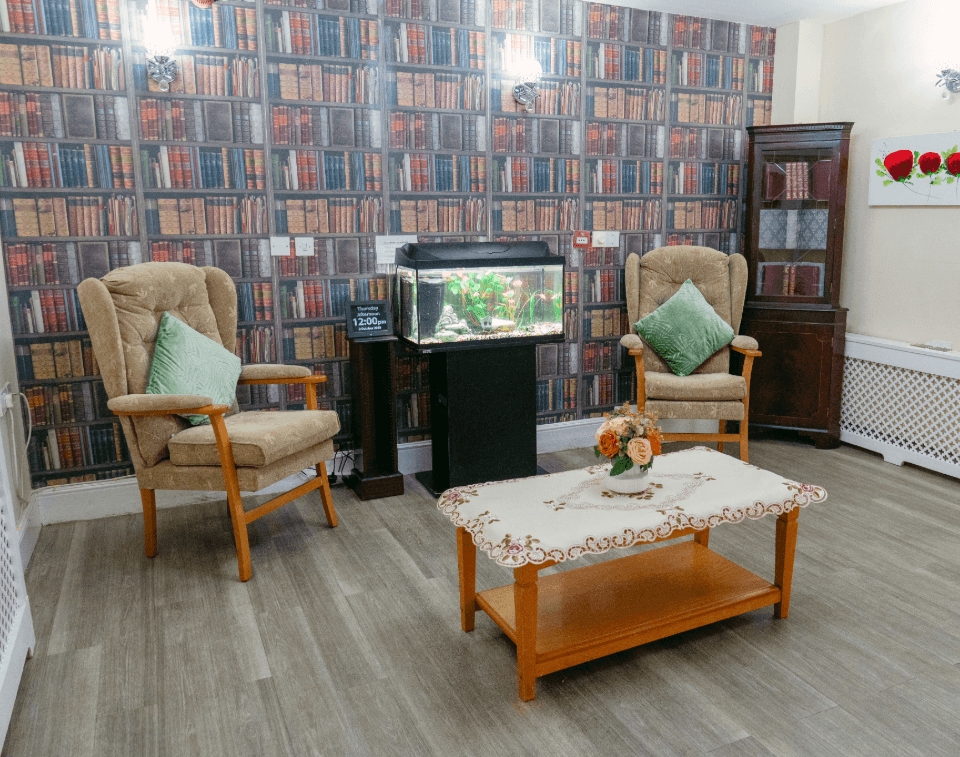
We encourage couples to bring their own furniture, photographs and favourite chairs. A double room with your own armchairs and your own bedside lamps feels like a home, not a ward. If you want to sleep in separate beds, that is a normal request.
What about the cost?
Fees at Stanborough Lodge start from £1,150 per week. For a couple in a double room, the cost depends on the room and on each person’s care needs, so we always give you a clear figure after a conversation rather than a guess online.
A few things are worth knowing before you speak to anyone:
- Each person’s care needs are assessed separately, even when you share a room.
- If one of you moves into a care home and the other stays at home, the family home is normally not counted in the means test for as long as your partner lives there. Check this with your council or an independent adviser, because the detail matters.
- If you are funding care yourselves, you can choose any home that suits you. If the council is helping, ask them early about keeping you together.
Our guide to when families should consider a care home covers the earlier part of this decision, and our residential care page explains what everyday life looks like.
Practical questions to ask any home
- Do you have double rooms, and how many?
- How long is the waiting list, and what do you offer in the meantime?
- Can you meet both our needs now, and if one of us needs more care later?
- Are you registered for nursing care, or residential only?
- Can we bring our own furniture, and can we keep separate beds?
- Can we visit together before deciding?
Take this list with you on your visit. How a manager answers matters as much as what they say. A home that is keen to help will give you straight answers.
A harder question, asked gently
Families sometimes ask what happens if one partner dies while the other is still living in the home. It is not an easy thing to raise, but it is better to know the answer than to wonder.
In a home where staff stay for years, the surviving partner is looked after by people who already know them and who knew their husband or wife. They do not have to move or start again. We think that is one of the strongest reasons to choose a small home with a consistent team.
In our experience, couples settle best when the whole family has met the team before the move. The first few weeks go smoother for everyone when there are familiar faces on day one.
Families often ask
Can a husband and wife share a room in a care home?
Yes, in homes that have double rooms. At Stanborough Lodge we have two. Not every home does, so ask before you visit.
What if one of us has dementia and the other does not?
This is common, and many couples do well together. Each of you has your own care plan. The partner without dementia keeps their independence, and the partner with dementia gets the comfort of having them close. Read more about what a good day looks like for a resident living with dementia.
What if we need different levels of care?
It depends on the home’s registration. A residential home can look after residential needs and dementia needs. If one of you needs nursing care, you need a home registered for nursing. Bentley Lodge and Cams Ridge both offer care and nursing.
Can we try it first?
Often, yes. A short stay is a gentle way to find out whether a home feels right. Subject to availability, ask about respite care at the home you like.
Do we have to share a bed?
No. Some couples share a bed, others want their own, and many have not shared a bed for years. Tell the manager what suits you.
Should we ask now, even if we are not ready?
Yes. Double rooms are limited, so an early conversation puts you on the list and gives you time to decide. It does not commit you to anything.
Come and meet the family who’ll care for yours
If you are thinking about care for you and your partner, the best next step is a conversation. We can tell you what is free, what is coming up, and whether we are the right fit. If we are not, we will tell you that too.